structure of a taiji class
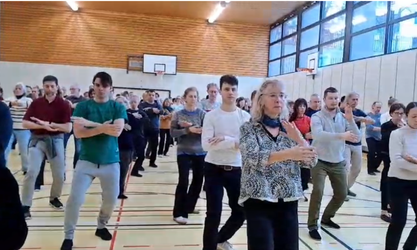
Each training session has the same structure and usually lasts 90 minutes. The fixed structure has proven to be very supportive of learning progress. During the course of the lesson, the physical exercises become increasingly complex. In the process, we try to get into a deeper state of mind. At the end of the class we meditate – and then we carry this refined state of mind into our everyday lives.
1 loosening exercises

At the beginning of each Taiji class we do the five loosening exercises from Master Huang Xingxian. With the loosening exercises we learn to release tension, bring the body into correct alignment and move gently.
At the same time we begin to bring the mind out of the busy consciousness into stillness and then even further inward.
A first step for this is to concentrate on the inner movements of the body.
2 taiji form
Beginners first learn Master Huang's short form, which is based on Zheng Manqing's 37-movement form.
In each Taiji lesson we look at one detail in more detail.
In practising the form, we learn to perceive the inner forces rising through the body, while the body itself is still sinking further and aligning itself.
Advanced students learn the long form (108 movements of Yang Cheng-Fu) and also practice Master Huang's Quickfist, a faster form.
3 pushing hands

Also called Tuishou (pushing hands).
There are eight basic pushing hands exercises, all of which are practised in every class.
These partner exercises are performed very sensitively and without force, in as deep a state of mind as possible. We learn to feel the energisation and activation of the muscles in ourselves, but
also in our partners, and to establish as gentle and good a connection as possible through the hands.
4 Applications / Issuing
The final part of the Pushing Hands exercises are the so-called applications.
At the beginning of the applications, one tries to relax the body completely and to yield to the oncoming force of the partner without resistance as soon as one feels the finest pressure.
This requires not only well-rooted feet and a stable stance, but also a deepened state of mind and a refinement of one's own taji.

5 Meditation
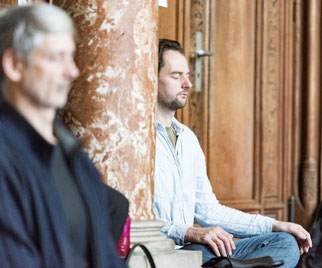
Each class ends with a meditation of about 15 minutes.
Meditation is an important and integral part of inner training (Neigong).